Empowering Futures: CU SMB Leads Its Members Toward Financial Freedom Through Financial Literacy Education

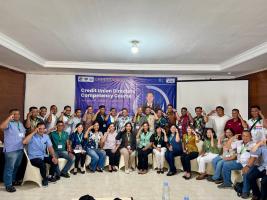
Financial literacy is more than just understanding money—it is a lifelong skill that empowers individuals to build stability, achieve freedom, and transform their lives. Through a series of structured financial education sessions, the Credit Union (CU) equips its members with the knowledge, tools, and mindset needed to manage finances wisely at every stage of life. On November 23, 2025, CU SMB held a financial literacy training attended by 18 active participants. During this activity, participants actively interacted in each session from session 1 to session 8, which were led by three facilitators representing the board and management of CU SMB.
 Presentation of sessions 1, 2, and 3 by Mr. Gatot Setiyawan
Session 1: The Mission of the Credit Union
The Credit Union exists as a platform for self-help, community empowerment, and collective growth. Its mission is grounded in cooperation helping members help themselves through disciplined financial management. CU provides a safe environment for members to learn how to handle money responsibly, improve financial behavior, and work toward long-term financial well-being. More than a financial institution, CU is a lifelong partner that guides its members toward financial independence and prosperity. As stated in its mission, “Meningkatkan kualitas hidup anggota melalui pemberdayaan ekonomi keluarga secara berkelanjutan”
Session 2: Products and Services of the Credit Union
To support members’ financial needs, CU offers a wide range of products and services, including Savings Accounts Members can save regularly and securely while earning returns over time. Loan Services, CU provides affordable and accessible loans for various purposes—education, emergencies, business development, and more. Capacity-Building Training, CU enriches its members through, Entrepreneurship training, Financial literacy workshops, Business management skill development, These services ensure that members not only access financial facilities but also gain the skills to use them wisely for personal and business growth.
Session 3: The Language of Wealth Creation
Wealth is not only about money—it begins with the mindset. This session teaches members how to understand financial concepts clearly and adopt a mindset oriented toward growth and prosperity. Key lessons include: Seeing money as a tool for building a better future Understanding the flow of income, expenses, assets, and liabilities Shifting from a consumption mindset to a productive mindset. Learning how simple financial habits can compound into wealth over time. By mastering the “language” of wealth, members can make smarter decisions that lead to sustainable financial progress.
 Presentation of sessions 4, 5, and 6 by Mrs. Christina Nurwiyati
Session 4: Personal Financial Management
Effective financial management is built upon essential principles. CU emphasizes 12 Personal Financial Management Rules, which serve as practical guidelines for daily financial behavior:
1. Set SMART Financial Goals
2. Live Within Your Means
3. Pay Off Debts
4. Maintain a Clean Credit Record
5. Make Rational Spending Decisions
6. Understand Opportunity Cost
7. Recognize the Time Value of Money
8. Understand the Power of Compound Interest
9. Take Appropriate Risks
10. Save Consistently
11. Invest with a New Perspective
12. Diversify Your Investments and Wealth
These principles help members build discipline, manage risks, and create opportunities for long-term growth.
Session 5: Smart Saving Strategies
Saving money is not a single act but a lifestyle practice. This session introduces more than ten practical saving strategies that anyone can apply Save before spending, Save even if you still have debt, Spend less than you earn, Create a detailed monthly budget, Eat healthy yet affordable meals, Collect spare change, Adopt “Green Ideas” such as growing vegetables or raising chickens, Shop only for necessities, Reduce water, phone, and electricity expenses, Avoid going to stores if you don’t need to buy anything, Stop comparing yourself to others, Live a simple lifestyle, Quit smoking, After paying off debt, increase your savings aggressively, Save bonuses or unexpected earnings, These habits strengthen financial resilience and accelerate wealth-building.
 word game: definition of emergency fund
 Word arrangement game results
Session 6: Emergency Funds
An emergency fund is a dedicated amount of money set aside exclusively for urgent and unexpected expenses. Examples include medical emergencies, accidents, job loss, or essential repairs.
Why It Matters?
- Prevents financial crisis
- Reduces dependence on high-interest loans
- Provides peace of mind and financial security
How to Build It?
Members are encouraged to save a small portion of income every month until they accumulate 3–6 months of living expenses. Consistency is more important than the amount, and the fund must be kept in a safe and easily accessible account.
Session 7: Financial Planning
Financial planning helps members turn dreams into concrete, achievable steps. This session teaches how to calculate and prepare for specific goals—for example, planning to buy a house. Members learn to Estimate total costs Determine timeframes. Break goals into monthly or annual savings targets. Evaluate risks and financial constraints. Choose saving or investment instruments that support the goal. A well-structured financial plan acts as a roadmap that guides decisions and keeps members on track.
Session 8: Setting Financial Goals
A strong financial journey begins with clear, meaningful, and realistic goals. Good financial goals are Specific, Measurable, Achievable, Relevant, Time-bound, Members learn how to define short-term, medium-term, and long-term financial objectives—such as building savings, buying property, starting a business, or preparing for retirement.
 certificate handover representative
Through these eight sessions, the Credit Union demonstrates its commitment to shaping financially intelligent, responsible, and empowered members. From understanding CU’s mission to mastering financial planning and wealth-building strategies, this comprehensive education equips members with the knowledge and confidence to achieve lifelong financial freedom. By learning, practicing, and applying these principles, every member has the opportunity to transform financial challenges into pathways toward prosperity.
 Photos of great people